
I will be taking postgraduate students at the Evolutionary Studies Institute, University of the Witwatersrand, from 2027: Honours students from the ESI cohort, Masters students, and possibly also doctoral students.
Enquiries are welcome at any time. If you are thinking about 2027 and want to talk it through first, write to me now rather than waiting.
Where you would be based
You would work in a fully functional palynology laboratory at the Evolutionary Studies Institute, which I am currently restocking and bringing up to date through the African Origins Platform grant. The lab has a fully trained and highly experienced technician available to me and to my students, a new Leica DM500 microscope purchased for student use, and a number of further microscopes available.
The Institute sits within one of the world’s leading palaeoscience communities, which means your project would be surrounded by people working on the archaeological and hominin side of the same questions.
What we work on
Projects are available at Honours, Masters and doctoral level, and I also co-supervise, across these methods:
- Pollen analysis, to reconstruct vegetation histories
- Dung fungal spore analysis, to investigate herbivory and human impacts on landscapes
- Sedimentary charcoal analysis, to reconstruct fire histories
- Phytolith analysis, to reconstruct vegetation histories
- Fossil diatom analysis, to reconstruct hydrological and oceanographic change
- Anthracology and macrobotanical analysis, for archaeological application and wood anatomy
These connect outward to botany, geology and sedimentology, zoology, ocean and coastal science, medicine (aeroallergens) and computer science (automation and machine learning for microfossil identification). If your background is in any of those and you want to work on the deep past, get in touch.
What you would actually do
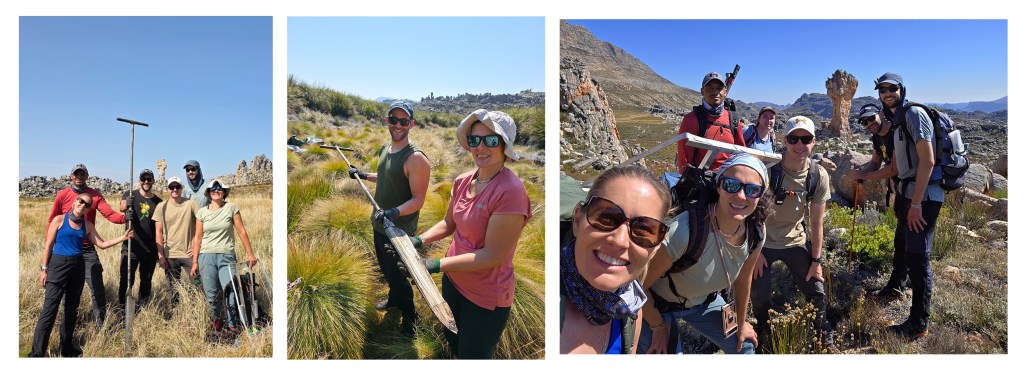
Most projects combine fieldwork, laboratory analysis and quantitative interpretation. Fieldwork means coring wetlands and lakes, and collecting rock hyrax middens in the mountains of the Cape Fold Belt. Laboratory work means sample processing and long hours at a microscope. Interpretation means chronologies, age-depth modelling and, increasingly, quantitative climate reconstruction methods.
You do not need prior palynological training. That training does not exist as an undergraduate offering in South Africa, and teaching it is part of what this group is for.
Funding
Students are expected to secure their own bursary funding. The two main routes are the National Research Foundation postgraduate funding programme and the Palaeontological Scientific Trust (PAST). Both have annual deadlines well ahead of registration, so start early and talk to me before you apply.
The costs of your analyses and laboratory resources at the Evolutionary Studies Institute are covered, by my research funding and by the School. You are responsible for your stipend and fees; you are not responsible for the cost of doing the science.
How to apply
Email me at lynne.quick1@wits.ac.za with:
- A short note on what draws you to palaeoecology and which of the methods above interests you
- Your CV
- Your academic transcript
I read everything and I reply. Please do not send a generic enquiry with no indication that you have looked at what we actually do.

